
Rewilding has been blamed for wildfires – but what does the science say?
First published in Philosophical Magazine.
If you spent the summer of 2026 in the Northern Hemisphere, you won’t have forgotten its record-busting heat. Wildfires blazed in nations including the UK, France, Spain, Italy, Portugal, the USA and Canada.
I spent the summer in Sussex, England. In some places we had just 0.3mm of rain in July. The UK faced its warmest ever summer and its driest July on record (which go back to 1836). By mid-August, the Prime Minister, Andy Burnham, had pronounced the nation a ‘tinderbox’, issued a warning alert to the phones of millions of members of the public and called in the military to support firefighters. At the time, 37 wildfires were alight in the UK. And while wildfires are a natural part of many ecosystems – triggering regrowth and revival – that’s not generally the case in the UK.
What on Earth could be the cause?
To many, it’s obvious: human-made climate change, exacerbated by a powerful El Niño event.
To others, there is another villain: rewilding.
For the uninitiated, rewilding is a way to restore landscapes and habitats, putting animals and natural processes in the driving seat – for example, allowing grazing and roaming large herbivores like cattle and ponies to shape the land.
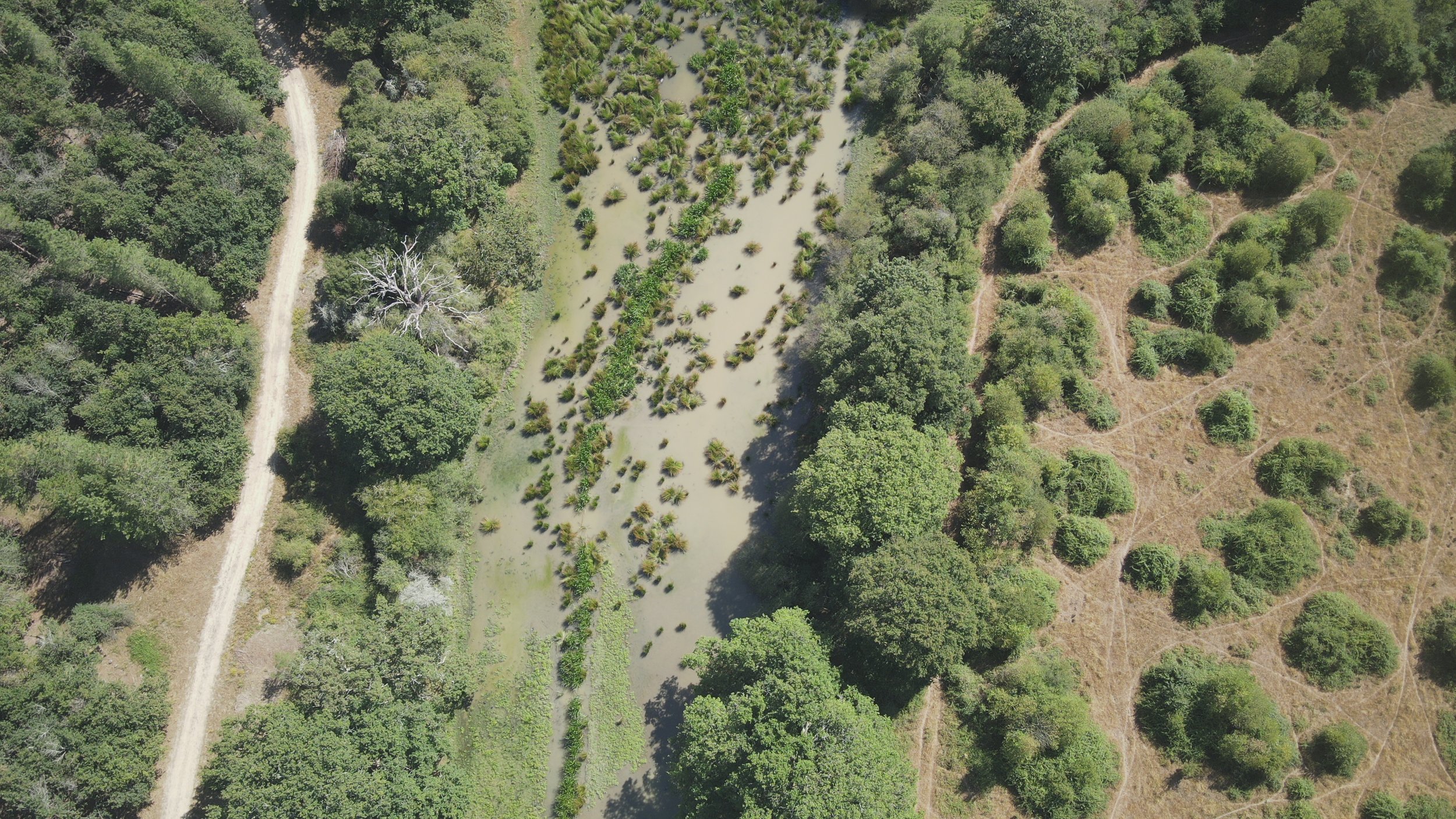
The rewilded wetland at Knepp during the heat and drought of summer 2026. Credit: Knepp.
A fiery debate
So, how could rewilding cause wildfires? Well, as the fires raged, so too did a debate.
National attention was awoken in the UK when a fire that started on the Royal Society for the Protection of Birds (RSPB) Minsmere reserve on the Suffolk coast spread onto the National Trust’s neighbouring Dunwich Heath. Holiday parks and homes were evacuated. By the time it was under control, around 370 acres of coastal heathland – home to nightjars, Dartford warblers and adders – had burned.
One broadsheet newspaper reported claims that the reserve had gone up in flames because of the reserve’s “rewilding agenda”. A tabloid went further with a front page blaming rewilding for the summer’s record fires. The apparent case against rewilding goes like this: if you stop managing the land, the vegetation will pile up. The more vegetation there is, the more fuel there will be for fires.
After Dunwich, the Countryside Alliance’s chief executive Tim Bonner accused conservation charities of refusing to manage vegetation out of “an obsession with rewilding”. The Moorland Association and the Country Land and Business Association both spoke out. Their particular concern was the government’s restrictions on controlled burning: the practice, common on grouse moors, of setting fire to patches of heather in rotation so that it regrows in a mosaic of different ages.
So, case closed? Not quite. The critics’ case falls short in three ways: what rewilding actually is, where the fires actually happened, and how the land would traditionally have been.
First, what the critics describe isn’t rewilding. Rewilding – as Joe Glentworth, Anna Gilchrist and Ian Thornhill from the University of Manchester (UK) wrote in The Conversation this summer – requires carefully planned action to restore natural processes. It’s not just about closing the field gate and walking away. Humans are key to rewilding just as they are key to other conservation approaches. The intervention of people is required to remove barriers for nature, introduce lost species, measure the changes, manage boundaries with neighboring land and host visitors as they witness nature’s revival.
Second, the places that burned weren’t rewilding projects. Dunwich Heath and Minsmere are long-established nature reserves, actively managed for heathland wildlife, with firebreaks and regular heather-cutting, according to the National Trust.
Third, there’s the grouse moor. Critics hold up rotational burning as the sensible, traditional answer. But these moors are managed for one very specific purpose: keeping heather at the right height for grouse to nest and for gun-holders to see them. What’s more, many are crisscrossed with drainage ditches designed to shed water, and so dry out the peat.
An ecological perspective
In search of a perspective from someone ‘on the ground’, I spoke with Matt Phelps. Matt is the Lead Ecologist at Knepp (West Sussex, UK), which is the UK’s best known rewilding project, founded by farmer-turned-environmentalist Charlie Burrell and author Isabella Tree.
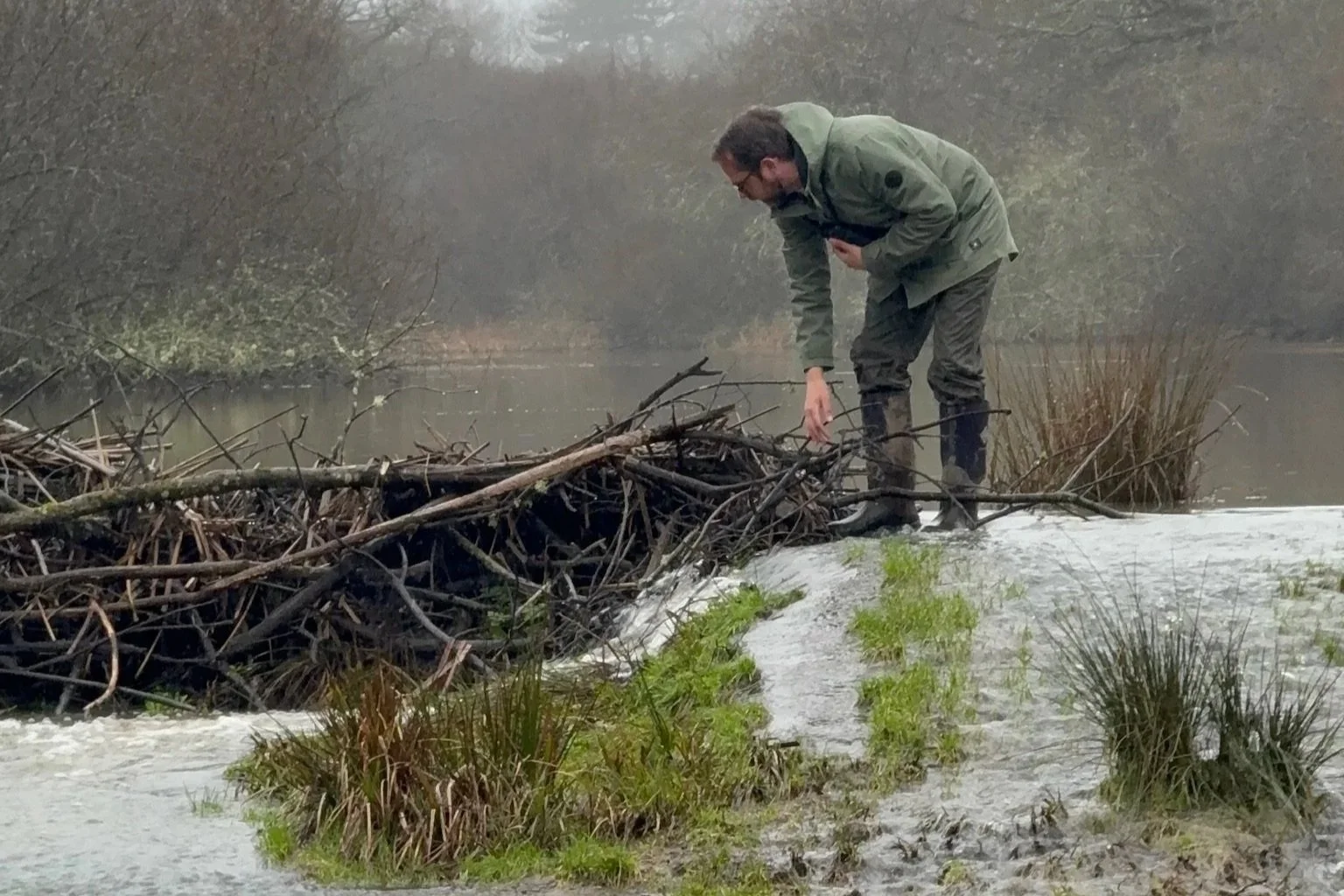
Matt Phelps looks at a beaver dam at Knepp, credit Anna Ford
I put the arguments of the Countryside Alliance and co to Matt. He explained the ecology. Heathland is a high-risk landscape: “They’re on sand. They’re free-draining soils, so they dry out more readily. And the vegetation is a mass of low-growing, quite woody, shrubby stuff. When the fire gets in, and you’ve got heatwaves and wind, it will just sweep across.”
But Matt says the need to burn indicates that something is missing from the ecosystem.
“Our ancestors weren’t going in purposefully burning stuff,” he remarked. “It would have been a complete waste of time. It’s usually because we’ve taken so many things out of the system that we’re having to replicate a lot of those natural processes.”
Research shows how the vegetation on the moors has changed. A team led by Antony Blundell at The University of Leeds (UK) analyzed peat records from Keighley Moor in West Yorkshire and found that for most of the past 1000 years, the landscape was wetter and richer in peat-forming Sphagnum moss. Sphagnum first appears around 590 CE. Until the early 1900s, it showed good resilience against fires, but around 1920, Sphagnum collapsed. The site's heaviest charcoal layer sits at that point, matching records of wildfires. It never recovered. The authors link the continued absence to ongoing systematic burning for grouse shooting, alongside the rise of heather. They say today's heather-dominated cover is "atypical" for the past thousand years.
Contrary to what some would argue, burning these landscapes for grouse-hunting is not the natural order of things. It is, in fact, the opposite, and leaves them drier and more prone to fire.
A 2024 study led by Noemi A.L. Naszarkowski at the University of Aberdeen (UK) looked at 92 sites across 42,000 hectares of burnt upland area in Scotland and found, perhaps unsurprisingly, that fires in dry heath burn noticeably more severely than in wet heath or blanket bog. Furthermore, they found other factors make fires more intense too, such as slope, aspect and elevation.
The moors that critics present as natural and well-managed are among our most fire-prone landscapes precisely because of how they’ve been managed.
Wildfires in wilder places
So that’s how not to do it. But how would a landscape in which nature is allowed to recover and flourish handle a heatwave?
I turn to Emily Fairfax, who is Associate Professor of Geography at the University of Minnesota (MN, USA). She researches the effect of wildfires on beaver wetlands – beavers being, perhaps, the most iconic species in rewilding projects. In a 2020 study, Emily and co-author Andrew Whittle found that beaver-dammed areas stay three times greener during wildfires. She has explained how this works in a wonderful stop-motion animation.
As Emily shared: “People are pretty good at evacuating during wildfires, but how do animals stay safe? Where can they go? Beaver wetlands! Our research has shown that beaver wetlands are uniquely resistant to burning during wildfires and create ‘refugia’, which are essentially safe patches of habitat that stay green.”
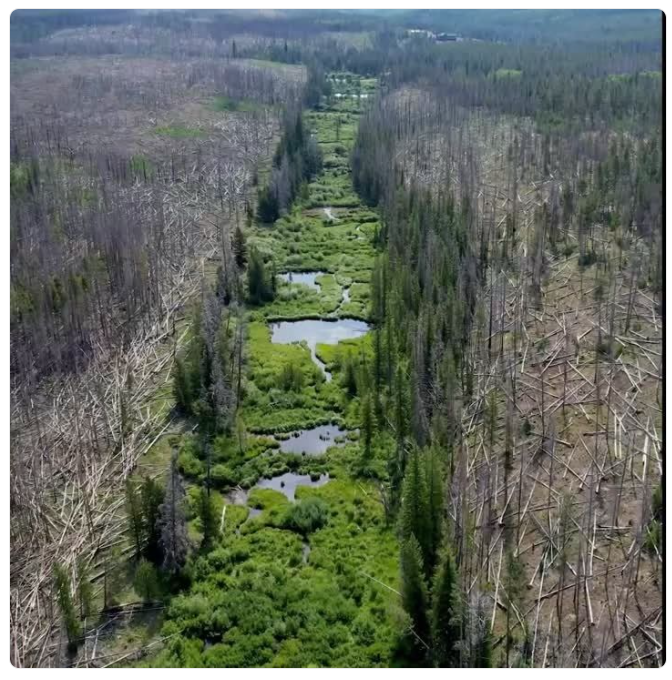
Research drone footage of Mullen Fire landscape, Wyoming, credit Emily Fairfax
Matt saw precisely this effect at Knepp too, as he explained when I asked him how the rewilding project had coped with the summer’s intense heat and lack of rain.
“It was pretty amazing actually. More managed landscapes and recreational parks and gardens were shockingly dry and shockingly bleached by the heat and the sun. At Knepp, there was still a residual greenness.
“And the beaver wetlands were just astonishing. Without exaggeration, that stretch of watercourse really hasn't changed much all year. The water level has been pretty stable. Water has continued to trickle through the dam. There's always been green vegetation. It's where all the cattle were going in the heat waves. We put the drone up and we could see clearly a green ribbon through that landscape.”
Matt made and shared a video of it at the time. You can see the verdant wetland contrasting with the brown surroundings and hear the water spilling through the dam.
What’s more, satellite layers on the European Union’s Copernicus Browser show the whole estate was wetter than the land around it in July and August.
“If something is lush and green and has a lot of water in it,” Matt explained, “then it’s not going to burn.” He’s careful not to overclaim though. Had a fire swept through Knepp, “there would have been places that burnt, just as there would anywhere.”
However, Knepp is full of natural firebreaks. The animals help: they trample paths through long grass and punch holes through scrub. “The picture the critics paint is of a completely impenetrable tangle of dry sticks,” he commented. “But there’s a lot of gaps in it because of the animals.”
Matt’s view is backed by research. A review of the effect of herbivores on wildfire risk, led by Julia Rouet-Leduc at Leipzig University (Germany), concluded that herbivores can mitigate wildfire damage. The study warned that abandoned areas do pose wildfire risks – for example, where vegetation is allowed to build unchecked – but that grazing by domestic or wild herbivores is a promising tool in reducing wildfire risk. Not only that, but it’s also cost-effective, and the animals provide other ecosystem services, too.
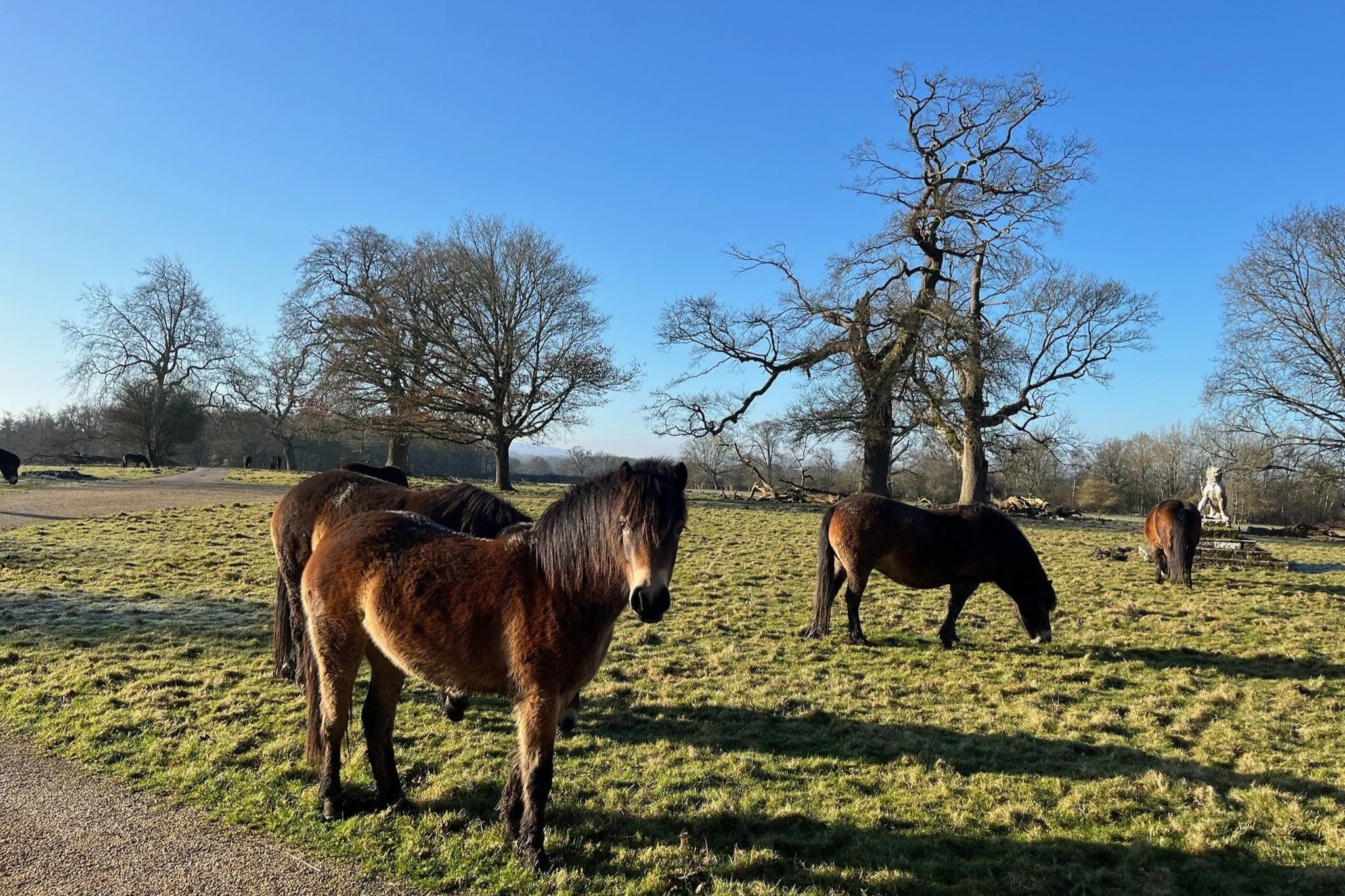
Free-roaming Exmoor ponies at Knepp. Credit Anna Ford
Their caveat is important. The lesson is clear that while the science suggests well-managed landscapes lower wildfire risk, abandoned or neglected ones may raise it.
What makes the difference is the deliberate decisions and species introductions that humans make.
So, if there’s a ‘call to action’, it’s that landscapes need to be returned to nature with care and in line with what research shows makes places resilient.
It is perhaps also that the word ‘rewilding’ is misunderstood and may be a lightning rod for reactive outrage. Perhaps we need a new term, like simply ‘nature recovery’.
It’s not just about wildfires
The same qualities that help recovered landscapes resist fire in summer also help them slow floods in winter. In both cases, it’s about enabling landscapes to hold water.
Last winter, Matt imparted, the area around Knepp had around 500mm of rain in three months. On conventionally drained land, most of that would have rushed straight off the fields, into the river and downstream, pulling soil along with it. At Knepp, a stretch of the River Adur that has been re-meandered spilled out across its floodplain and held, in Matt’s words, “a colossal amount of water.”
This is what rivers are supposed to do. “We think of a river flooding as a problem,” he commented. But the real problem is pushing the water elsewhere. “If you canalise most of your river, it’s going to end up rushing downstream and out into someone’s front room somewhere.”
As we face a future with more extreme weather events, we need to look closely at how we manage land. We can keep draining it, burning it and treating water as the enemy, and keep paying for it in scorched heaths and flooded front rooms. Or we can help nature rebuild its own defences: wet bogs, wandering rivers, beaver ponds, native woods and wild herds.
In the midst of the UK’s hottest summer on record, the free-roaming animals at Knepp headed to the wetlands. Emily Fairfax has seen the same in the USA. The science suggests we’d be pretty foolish not to follow in their tracks.